
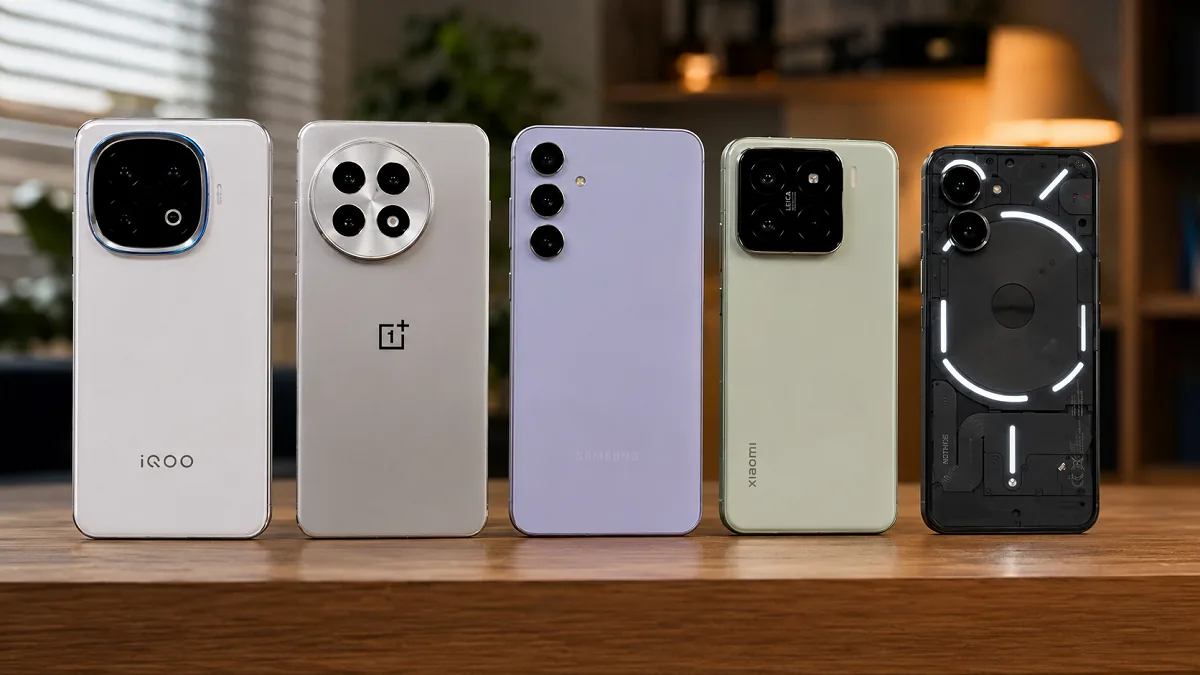
Best Smartphones Under ₹70,000 in India 2026: Latest Premium Phones Compared
Buying a premium smartphone in 2026 no longer means spending ₹1 lakh or more. The best smartphones under ₹70,000 in India now offer flagship-class processors, high-refresh-rate AMOLED displays, advanced camera systems, large batteries, fast charging and increasingly capable AI features.
But choosing the right premium phone is not simply about finding the device with the highest benchmark score or the biggest camera sensor. A phone that is excellent for competitive gaming may not be the best choice for photography, while a compact camera-focused flagship may not offer the battery capacity that a heavy user needs.
For this updated 2026 buying guide, we have focused on smartphones that offer a strong premium experience while remaining within or around the ₹70,000 ceiling for an eligible configuration.
How This Guide Was Evaluated:
- Current official specifications
- Processor and graphics capabilities
- Display technology and refresh rate
- Camera hardware and versatility
- Battery capacity and charging support
- RAM and storage configuration
- Software experience and update support
- Durability and premium features
- Current or officially listed India pricing
Prices can change because of sales, bank offers, exchange discounts and manufacturer revisions. For that reason, buyers should always check the final retail price before ordering.
Best Smartphones Under ₹70,000 in 2026: Quick Picks
- Best Performance-Focused Phone: iQOO 13
- Best All-Round Flagship: OnePlus 13
- Best Samsung Experience: Samsung Galaxy S25 FE
- Best Compact Flagship: Xiaomi 15
- Best Distinctive Android Experience: Nothing Phone (3)
- Best Value Alternative: OnePlus 13R
1. iQOO 13 – Best Performance-Focused Smartphone Under ₹70,000
The iQOO 13 remains one of the strongest choices for buyers who place gaming and raw performance near the top of their priority list. It combines Qualcomm’s Snapdragon 8 Elite flagship platform with iQOO’s dedicated Q2 supercomputing chip and a large vapor-chamber cooling system.
iQOO 13 Key Specifications
- Processor: Snapdragon 8 Elite
- Display: 6.82-inch 2K AMOLED
- Refresh Rate: Up to 144Hz
- RAM: Up to 16GB
- Storage: Up to 512GB
- Rear Cameras: 50MP + 50MP + 50MP
- Battery: 6,000mAh
- Charging: 120W FlashCharge
- Cooling: 7K Ultra VC cooling system
- Protection: IP68 + IP69
The display is another major strength. Its 6.82-inch 2K AMOLED panel supports up to a 144Hz refresh rate, making the phone particularly attractive for gaming as well as high-quality media consumption.
Battery hardware is equally aggressive. The iQOO 13 packs a 6,000mAh battery with 120W FlashCharge, giving it a combination of large capacity and very fast wired charging.
The phone is not limited to gaming hardware either. Its rear camera system consists of three 50MP cameras, giving buyers considerably more imaging flexibility than a typical gaming-focused smartphone.
For users who want maximum performance without crossing the ₹70,000 mark, the iQOO 13 remains one of the most compelling options to compare in 2026.
2. OnePlus 13 – Best All-Round Flagship Under ₹70,000
The OnePlus 13 deserves a prominent position in this price category because its 12GB RAM and 256GB storage variant carries an official MRP of ₹69,999, putting a genuine OnePlus flagship directly at the ₹70,000 ceiling.
OnePlus 13 Key Specifications
- Processor: Snapdragon 8 Elite
- Display: 6.82-inch QHD+ ProXDR LTPO display
- Refresh Rate: 1–120Hz dynamic
- RAM: 12GB LPDDR5X on the ₹69,999 variant
- Storage: 256GB UFS 4.0
- Battery: 6,000mAh
- Software: OxygenOS
The Snapdragon 8 Elite gives the OnePlus 13 true flagship-level processing hardware, while the 3168 × 1440 QHD+ LTPO display combines high resolution with a dynamically adjustable refresh rate of 1–120Hz.
The 6,000mAh battery also makes the OnePlus 13 particularly attractive to users who want flagship performance without sacrificing battery capacity.
Its biggest advantage in this comparison is balance. Rather than concentrating almost entirely on gaming or one headline specification, the OnePlus 13 combines a premium display, flagship processor, capable cameras, large battery and polished OxygenOS experience in one package.
For buyers with a budget that genuinely extends to ₹70,000, the OnePlus 13 should be compared before choosing a cheaper “flagship killer.”
3. Samsung Galaxy S25 FE – Best Samsung Experience Under ₹70,000
The Samsung Galaxy S25 FE is aimed at buyers who value Samsung’s software ecosystem, camera features and long-term usability more than benchmark-leading gaming performance.
Samsung’s current Indian store listing shows the 128GB version at ₹54,999 and the 256GB configuration at ₹60,999 at the time of this update, although prices and availability can change.
Samsung Galaxy S25 FE Key Highlights
- Display: 6.7-inch Dynamic AMOLED 2X
- Refresh Rate: Up to 120Hz
- Processor: Exynos 2400
- Main Camera: 50MP
- Ultra-Wide Camera: 12MP
- Telephoto Camera: 8MP with 3x optical zoom
- Front Camera: 12MP
- Software: One UI
The camera system is one of the S25 FE’s strongest reasons for consideration. A dedicated 3x telephoto camera adds genuine optical versatility, while Samsung’s software and image-processing ecosystem makes the device particularly relevant for users who frequently capture photos and videos.
The Galaxy S25 FE is therefore less about winning a raw-performance contest and more about providing a well-rounded Samsung flagship-style experience at a lower price than the company’s most expensive Galaxy S models.
4. Xiaomi 15 – Best Compact Flagship Under ₹70,000
The Xiaomi 15 stands out from many premium Android phones because it delivers high-end hardware in a relatively compact body. Its 6.36-inch CrystalRes AMOLED display makes it especially interesting for buyers who do not want an oversized flagship.
Xiaomi 15 Key Specifications
- Processor: Snapdragon 8 Elite
- Display: 6.36-inch CrystalRes AMOLED
- Refresh Rate: 1–120Hz
- RAM: 12GB LPDDR5X
- Storage: 512GB UFS 4.0
- Main Camera: 50MP Leica
- Telephoto: 50MP Leica floating telephoto
- Ultra-Wide: 50MP
- Front Camera: 32MP
- Battery: 5,240mAh
- Wired Charging: 90W HyperCharge
- Wireless Charging: 50W
- Protection: IP68
Its camera hardware is particularly notable. Xiaomi uses a Leica-branded triple 50MP rear camera system consisting of a main camera, floating telephoto and ultra-wide camera.
Despite its relatively compact dimensions, Xiaomi has fitted a 5,240mAh battery with 90W wired and 50W wireless charging. Wireless charging is an important premium feature that is not available on every performance-oriented phone in this price range.
For buyers looking for flagship performance, versatile cameras and a smaller form factor, the Xiaomi 15 is one of the most interesting alternatives in the category.
5. Nothing Phone (3) – Best Distinctive Android Experience
The Nothing Phone (3) takes a different approach from conventional premium smartphones. Instead of competing only on benchmark numbers, Nothing combines distinctive hardware design, the Glyph Matrix interface, Nothing OS and AI-assisted Essential features with capable premium hardware.
Nothing Phone (3) Key Specifications
- Processor: Snapdragon 8s Gen 4
- Display: 6.67-inch flexible AMOLED
- Resolution: 1260 × 2800 pixels
- Refresh Rate: Up to 120Hz
- Memory: LPDDR5X RAM
- Storage: UFS 4.0
- Camera System: Four 50MP cameras including the front camera
- Video: Up to 4K 60fps
- Wireless Charging: 15W
- Reverse Wireless Charging: 5W
- Protection: IP68
Performance comes from the Snapdragon 8s Gen 4. It is a powerful platform for demanding applications and gaming, although buyers focused purely on maximum flagship performance should note that phones such as the iQOO 13, OnePlus 13 and Xiaomi 15 in this comparison use the higher-tier Snapdragon 8 Elite.
Nothing has placed considerable emphasis on photography this generation. Phone (3) features an all-50MP camera system, including a periscope camera, while video recording extends to 4K at 60fps.
The other major differentiator is software. Nothing OS combines the company’s minimalist visual language with Essential Space, Essential Search and other AI-assisted productivity features. The Glyph Matrix on the rear also gives Phone (3) an identity that is difficult to confuse with another Android flagship.
For buyers who want their premium smartphone to feel different rather than simply chasing the fastest chipset, the Nothing Phone (3) is one of the most distinctive choices in this category.
6. OnePlus 13R – Best Value Premium Alternative
The OnePlus 13R does not need the full ₹70,000 budget to deliver a high-end Android experience. OnePlus officially lists the 12GB + 256GB model at ₹42,999 MRP, while the 16GB + 512GB configuration is ₹49,999.
OnePlus 13R Key Specifications
- Processor: Snapdragon 8 Gen 3
- Display: 6.78-inch ProXDR LTPO 4.1
- Resolution: 2780 × 1264 pixels
- Refresh Rate: 1–120Hz dynamic
- RAM: 12GB / 16GB LPDDR5X
- Storage: 256GB / 512GB UFS 4.0
- Main Camera: 50MP Sony LYT-700 with OIS
- Telephoto: 50MP with 2x optical zoom
- Ultra-Wide: 8MP
- Battery: 6,000mAh
- Charging: 80W SUPERVOOC
- Software: OxygenOS
The Snapdragon 8 Gen 3 remains a powerful flagship-class platform for gaming, multitasking and demanding applications. It is paired with LPDDR5X memory and UFS 4.0 storage, so the 13R still offers strong core hardware despite costing considerably less than the ₹70,000 ceiling.
Its 6,000mAh battery and 80W SUPERVOOC charging are another strong combination. The 6.78-inch LTPO display can dynamically operate between 1Hz and 120Hz, balancing smoothness with power efficiency depending on the content.
Camera hardware is also more versatile than the previous generation’s typical performance-focused setup. The 50MP Sony LYT-700 main camera includes OIS, while a separate 50MP 2x telephoto camera handles portraits and optical zoom.
The important buying decision is therefore not whether the OnePlus 13R is capable—it clearly is—but whether you actually need to spend closer to ₹70,000. Buyers seeking Snapdragon 8 Elite performance, a higher-resolution display and a more complete flagship package should consider the OnePlus 13. Those looking for stronger price-to-performance value may find the OnePlus 13R more sensible.
Best Smartphones Under ₹70,000: Quick Comparison
| Smartphone | Processor | Main Strength | Battery | Best For |
|---|---|---|---|---|
| iQOO 13 | Snapdragon 8 Elite | Performance & Gaming | 6,000mAh | Performance-focused users |
| OnePlus 13 | Snapdragon 8 Elite | All-round flagship package | 6,000mAh | Premium all-round users |
| Samsung Galaxy S25 FE | Exynos 2400 | Samsung ecosystem & cameras | 4,900mAh | Samsung and long-term users |
| Xiaomi 15 | Snapdragon 8 Elite | Compact design & Leica cameras | 5,240mAh | Compact flagship buyers |
| Nothing Phone (3) | Snapdragon 8s Gen 4 | Nothing OS & distinctive design | 5,150mAh* | Design and software-focused users |
| OnePlus 13R | Snapdragon 8 Gen 3 | Price-to-performance value | 6,000mAh | Value-focused premium buyers |
*Battery specifications can vary by regional model. Always check the exact India retail configuration before purchase.
Which Smartphone Under ₹70,000 Should You Buy in 2026?
There is no single best smartphone under ₹70,000 for every buyer. The iQOO 13, OnePlus 13, Samsung Galaxy S25 FE, Xiaomi 15, Nothing Phone (3) and OnePlus 13R have noticeably different strengths. The right choice depends on whether you prioritize gaming, cameras, battery life, compact design, software or overall value.
Best for Gaming and Performance: iQOO 13
For performance-focused users, the iQOO 13 is one of the strongest choices in this comparison. The Snapdragon 8 Elite platform, dedicated Q2 chip, 144Hz 2K AMOLED display and large vapor-chamber cooling system give it hardware specifically suited to demanding workloads and gaming.
Its 6,000mAh battery and 120W charging are also useful for heavy users. Buyers should remember, however, that actual gaming frame rates and temperatures depend on the game, graphics settings, ambient temperature and software optimization.
Best All-Round Flagship: OnePlus 13
The OnePlus 13 is arguably the most complete all-round option for someone willing to use almost the entire ₹70,000 budget. It combines Snapdragon 8 Elite performance with a high-resolution LTPO display, 6,000mAh battery and a premium flagship feature set.
Its advantage is balance. Rather than being aimed primarily at one type of user, it is suitable for gaming, photography, multimedia, multitasking and everyday premium smartphone use.
Best Samsung Experience: Galaxy S25 FE
The Samsung Galaxy S25 FE makes the most sense for users who value Samsung’s One UI ecosystem, versatile cameras and long software-support commitment.
Samsung promises seven generations of operating-system upgrades and seven years of security updates for the Galaxy S25 FE, making software longevity one of its strongest advantages.
Its 50MP main camera is accompanied by a 12MP ultra-wide and an 8MP telephoto camera with 3x optical zoom, giving users three genuinely different rear-camera perspectives.
Best Compact Flagship: Xiaomi 15
Large-screen Android phones dominate the premium market, which makes the Xiaomi 15 particularly interesting. Its 6.36-inch AMOLED display provides a more compact alternative without dropping to mid-range performance hardware.
The Snapdragon 8 Elite, Leica triple 50MP rear-camera system, 5,240mAh battery, 90W wired charging and 50W wireless charging make it a feature-rich option for buyers who want flagship specifications in a smaller form factor.
Best for Distinctive Design and Software: Nothing Phone (3)
The Nothing Phone (3) is aimed at buyers who want something visually and functionally different from conventional Android flagships. Nothing OS, Essential Space and the Glyph Matrix give the phone a distinctive identity.
Its Snapdragon 8s Gen 4 is capable hardware, but buyers whose number-one priority is maximum chipset performance should compare it carefully with Snapdragon 8 Elite devices such as the iQOO 13, OnePlus 13 and Xiaomi 15.
Best Value Premium Phone: OnePlus 13R
The OnePlus 13R is the value option in this group. Its Snapdragon 8 Gen 3, 120Hz LTPO display, 6,000mAh battery and 80W charging deliver much of the experience buyers expect from a premium Android smartphone without requiring the full ₹70,000 budget.
If saving roughly ₹20,000–₹25,000 is more important than having the newest flagship processor and every premium feature, the OnePlus 13R deserves serious consideration.
Performance Comparison
For buyers focused primarily on processing power, chipset generation matters. The iQOO 13, OnePlus 13 and Xiaomi 15 use Qualcomm’s Snapdragon 8 Elite, placing them in the highest performance tier among the phones covered here.
| Smartphone | Processor | Performance Positioning |
|---|---|---|
| iQOO 13 | Snapdragon 8 Elite | Flagship / Gaming Focus |
| OnePlus 13 | Snapdragon 8 Elite | Flagship |
| Xiaomi 15 | Snapdragon 8 Elite | Flagship |
| Nothing Phone (3) | Snapdragon 8s Gen 4 | Premium |
| OnePlus 13R | Snapdragon 8 Gen 3 | Previous-Generation Flagship |
| Samsung Galaxy S25 FE | Exynos 2400 | Premium Samsung |
A newer or faster chipset does not automatically make a phone better overall. Thermal management, software optimization, RAM, storage speed and individual application optimization also affect real-world performance.
Camera Comparison
Camera buyers should avoid choosing a smartphone purely by megapixel count. Sensor quality, lenses, optical stabilization, telephoto capability, computational photography and video processing can be more important than the headline resolution.
The Xiaomi 15 stands out with its Leica-branded triple 50MP system, including a dedicated floating telephoto camera. The OnePlus 13 also provides a versatile flagship camera system, while the Galaxy S25 FE offers a dedicated 3x optical telephoto camera and Samsung’s established image-processing ecosystem.
Nothing Phone (3) also takes photography more seriously than earlier Nothing devices, while iQOO 13 combines its performance focus with a triple 50MP rear-camera configuration.
For a definitive camera winner, buyers should compare full-resolution photographs and video samples taken under the same lighting conditions rather than relying only on specifications.
Battery and Charging Comparison
| Smartphone | Battery | Key Charging Feature |
|---|---|---|
| iQOO 13 | 6,000mAh | 120W wired charging |
| OnePlus 13 | 6,000mAh | High-speed wired and wireless charging support |
| OnePlus 13R | 6,000mAh | 80W SUPERVOOC |
| Xiaomi 15 | 5,240mAh | 90W wired + 50W wireless |
| Nothing Phone (3) | 5,150mAh* | Wired + 15W wireless charging |
| Samsung Galaxy S25 FE | 4,900mAh | Wired and wireless charging |
*Check the exact Nothing Phone (3) regional configuration before purchase.
Battery capacity should not be used as a direct measurement of battery life. Display resolution, refresh rate, chipset efficiency, network conditions, background applications and software optimization can substantially change real-world endurance.
Long-Term Software Support Matters
When spending ₹50,000–₹70,000 on a smartphone, software longevity should be part of the buying decision. A phone that remains secure and receives major operating-system upgrades for several years can provide considerably better long-term value.
Samsung is particularly competitive here because the Galaxy S25 FE is promised seven generations of OS upgrades and seven years of security updates. Other manufacturers also provide multi-year update policies, but buyers should check the exact commitment for the specific model rather than assuming every phone from a brand receives identical support.
Best Smartphone Under ₹70,000 by User Type
| User Type | Recommended Smartphone | Main Reason |
|---|---|---|
| Performance / Gaming | iQOO 13 | Snapdragon 8 Elite, Q2 chip, 144Hz display and large cooling system |
| All-Round Premium User | OnePlus 13 | Strong balance of performance, display, battery and flagship features |
| Samsung User | Galaxy S25 FE | One UI, versatile cameras and long software support |
| Compact Phone Buyer | Xiaomi 15 | 6.36-inch body with Snapdragon 8 Elite and Leica cameras |
| Design / Software Enthusiast | Nothing Phone (3) | Nothing OS, Glyph Matrix and distinctive design |
| Value-Focused Buyer | OnePlus 13R | Premium hardware at a substantially lower price |
Should You Spend the Full ₹70,000?
Not necessarily. A ₹70,000 budget should be treated as a maximum rather than a target.
If the features you need are already available on a phone such as the OnePlus 13R, spending another ₹20,000 or more may provide relatively little practical benefit for your usage. On the other hand, users who want Snapdragon 8 Elite performance, more sophisticated camera hardware, wireless charging or other flagship features may find the additional expenditure worthwhile.
The better strategy is to identify the features you actually use and then buy the least expensive phone that delivers them well.
How to Choose the Best Smartphone Under ₹70,000 in 2026
A ₹70,000 budget gives buyers access to genuinely premium Android smartphones, but the most expensive option is not automatically the best one. Before buying, compare the features that directly affect how you use your phone rather than focusing only on benchmark scores or marketing claims.
1. Processor and Performance
If gaming, video editing or demanding multitasking is your priority, processor choice matters. The Snapdragon 8 Elite used by the iQOO 13, OnePlus 13 and Xiaomi 15 provides flagship-class performance, while the Snapdragon 8 Gen 3 in the OnePlus 13R remains powerful despite belonging to an earlier generation.
Chipset specifications alone are not enough, however. Cooling, software optimization and sustained performance can determine how well a phone performs during longer workloads.
2. AMOLED Display Quality
Most premium phones in this category offer high-refresh-rate AMOLED displays, but resolution, brightness, LTPO support and panel size still vary.
Gamers may prefer a large high-refresh-rate panel such as the 144Hz display on the iQOO 13, while buyers who prefer a smaller phone may find the Xiaomi 15’s 6.36-inch AMOLED display easier to handle.
3. Camera Versatility
A premium smartphone should be evaluated on more than its main-camera megapixel count. Check whether the device includes optical image stabilization, a useful ultra-wide camera and a dedicated telephoto lens.
The Xiaomi 15’s Leica triple-camera system, the OnePlus 13’s flagship camera setup and Samsung Galaxy S25 FE’s dedicated 3x optical telephoto camera make them particularly relevant for buyers who want more photographic flexibility.
4. Battery and Charging
Battery capacities around 5,000mAh and above are common in this category, with devices such as the iQOO 13, OnePlus 13 and OnePlus 13R reaching 6,000mAh.
Charging technology also matters. The iQOO 13 supports 120W wired charging, while the Xiaomi 15 combines 90W wired charging with 50W wireless charging. Buyers interested in wireless charging should check carefully because it is not available on every phone in this price segment.
5. Software Updates
Software support becomes increasingly important when buying an expensive smartphone that you plan to keep for several years.
The Samsung Galaxy S25 FE is particularly strong in this area, with Samsung promising seven generations of operating-system upgrades and seven years of security updates. For other models, buyers should check the manufacturer’s official update commitment for the exact device.
6. RAM and Storage
For a premium smartphone in 2026, 12GB RAM and 256GB storage provide a comfortable starting point for demanding users. Buyers who record large amounts of high-resolution video, install large games or plan to keep their phone for several years may benefit from 512GB storage.
Also check storage technology. UFS 4.0 storage, available on several phones in this comparison, offers faster data access than older storage standards.
7. Do Not Ignore Size and Weight
Specification sheets often overlook comfort. A large 6.8-inch flagship may provide an excellent gaming and video experience but can be less comfortable for one-handed use.
The Xiaomi 15 is particularly relevant here because its 6.36-inch display gives buyers a relatively compact flagship alternative without sacrificing a high-end processor or versatile camera system.
Frequently Asked Questions
Which is the best smartphone under ₹70,000 in India in 2026?
There is no universal winner, but the OnePlus 13 is one of the strongest all-round options within the ₹70,000 ceiling because it combines Snapdragon 8 Elite performance, a QHD+ LTPO display, a large 6,000mAh battery and premium flagship hardware.
Which phone under ₹70,000 is best for gaming?
The iQOO 13 is one of the strongest gaming-focused choices in this comparison. It combines the Snapdragon 8 Elite with a dedicated Q2 chip, up to a 144Hz 2K AMOLED display, a large vapor-chamber cooling system and a 6,000mAh battery with 120W charging.
Which smartphone under ₹70,000 is best for cameras?
The Xiaomi 15, OnePlus 13 and Samsung Galaxy S25 FE are all worth comparing for photography. The Xiaomi 15 offers a Leica-branded triple 50MP rear-camera system, while the Galaxy S25 FE provides a dedicated 3x optical telephoto camera. Actual camera quality should be compared using real photographs and videos rather than megapixel numbers alone.
Which is the best compact flagship under ₹70,000?
The Xiaomi 15 is one of the most attractive compact flagship choices in this group. It combines a 6.36-inch AMOLED display with the Snapdragon 8 Elite, Leica cameras, a 5,240mAh battery and both wired and wireless fast charging.
Is the OnePlus 13R worth buying if my budget is ₹70,000?
Yes, particularly if value matters more than spending your entire budget. The OnePlus 13R offers a Snapdragon 8 Gen 3 processor, LTPO display, 6,000mAh battery and 80W charging while costing substantially less than ₹70,000.
However, buyers willing to spend the full budget should also compare the OnePlus 13, which moves to the newer Snapdragon 8 Elite platform and offers a more complete flagship package.
Is 12GB RAM enough for a flagship smartphone in 2026?
For most users, 12GB of physical RAM is more than sufficient for everyday multitasking, gaming and demanding applications. Storage capacity may become a more important consideration for users who record large amounts of video or install many large games.
Should I choose 256GB or 512GB storage?
256GB is sufficient for many users, but 512GB can be worthwhile for people who record high-resolution video, maintain large offline media libraries, install multiple large games or plan to keep the phone for several years.
Which phone has the best software support?
Among the devices covered here, the Samsung Galaxy S25 FE has a particularly strong official commitment. Samsung promises seven generations of OS upgrades and seven years of security updates for the device.
Should I wait for a newer phone instead of buying now?
Waiting can make sense when a major replacement model is close to launch, especially if you do not urgently need a new phone. New launches can also reduce the prices of existing flagships.
However, a newer model is not automatically better value. A discounted previous-generation flagship can sometimes offer stronger hardware than a newly launched phone at the same price.
Best Smartphones Under ₹70,000 in 2026: Final Recommendations
| Priority | Our Pick |
|---|---|
| Gaming & Performance | iQOO 13 |
| Best All-Round Flagship | OnePlus 13 |
| Samsung Experience & Long Software Support | Samsung Galaxy S25 FE |
| Compact Flagship & Leica Cameras | Xiaomi 15 |
| Distinctive Design & Software | Nothing Phone (3) |
| Best Value Premium Alternative | OnePlus 13R |
Final Verdict
The best smartphones under ₹70,000 in India in 2026 now offer enough performance and premium hardware that most buyers do not need to move into the ₹1 lakh-plus category to get a flagship-level Android experience.
For performance-focused buyers, the iQOO 13 remains particularly compelling because of its Snapdragon 8 Elite platform, 144Hz display, large cooling system and 120W charging.
If you want the strongest overall balance and are prepared to spend close to the full ₹70,000 budget, the OnePlus 13 is one of the most complete choices. It combines flagship performance, a premium LTPO display, large battery and a broader flagship feature set.
The Samsung Galaxy S25 FE makes more sense for users invested in Samsung’s ecosystem and those who place a high value on long software support. The Xiaomi 15 is particularly attractive for buyers who want Snapdragon 8 Elite performance and versatile Leica cameras in a relatively compact body.
Nothing Phone (3) offers a more distinctive design and software experience, while the OnePlus 13R demonstrates that you do not necessarily need to spend the entire ₹70,000 budget to get powerful premium hardware.
Ultimately, the best choice depends on your priorities. Compare the final selling price, storage variant, camera requirements, software-support policy and features you will actually use before buying.
Editorial Note:
This buying guide is based on official manufacturer specifications, officially announced features and pricing information available at the time of the latest update. It does not claim hands-on testing where independent physical testing has not been performed.
Smartphone prices and promotional offers can change frequently. Always verify the current price and exact RAM/storage configuration before purchasing.
The graphics are stunning and the gameplay is just fluid. It is so much better than other sites I have used in the past. Check out bdx999game
Joined this club last week and the experience has been great. The winning rate seems better than other sites. Love krktwin8club!
Finally found a place that treats its members like actual VIPs. The rewards are generous and the customer support is always on point. Give 17krvip a try